

Carlsbad Caverns National Park and Guadalupe Mountains National Park sit close enough to combine in one road trip, yet they feel completely different. One is built around a huge underground cave system; the other is a hiking park of exposed limestone peaks, canyons and desert. Three days is the minimum I like for enjoying both without turning the trip into a race.
The most important planning detail is that the parks are in different states and operate on Mountain Time, while the broader West Texas region can create time-zone confusion for travelers moving east. Use the official park time for reservations and trail-gate deadlines, not whatever your phone happens to display near a boundary.
Three-day itinerary at a glance
| Day 1 | Carlsbad Caverns | Natural Entrance + Big Room + Bat Flight |
| Day 2 | Guadalupe Mountains | Guadalupe Peak OR McKittrick Canyon |
| Day 3 | Second park day | Shorter hike, cave tour or surface desert stop |
Day 1: Carlsbad Caverns
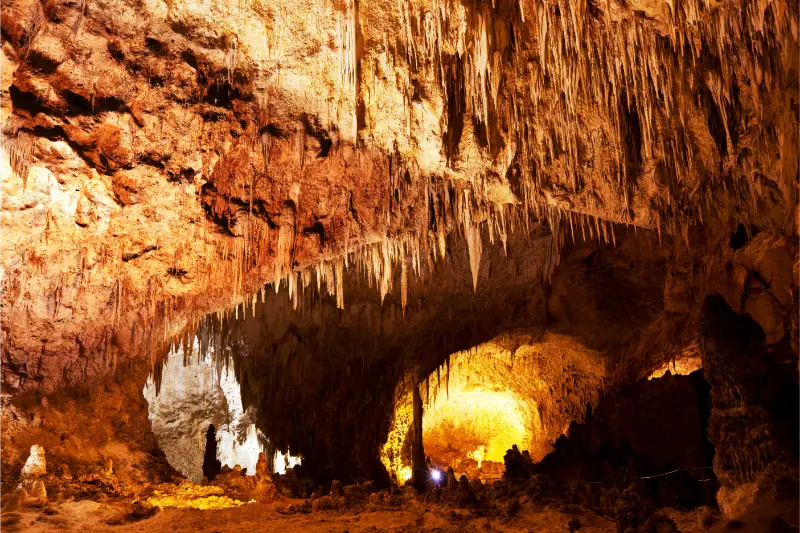
Reserve an early or mid-morning cavern-entry window. If everyone is physically comfortable, descend the Natural Entrance, then walk the Big Room and return by elevator. If knees or mobility are a concern, use the elevator both ways and spend the saved energy underground.
After lunch, keep the afternoon light. In bat season, return to the amphitheater for the free Bat Flight Program. Do not stack a long desert hike between the cave and the evening program unless the weather is unusually comfortable and the group has plenty of energy.
Day 2: choose one major Guadalupe Mountains objective
Do not plan Guadalupe Peak and McKittrick Canyon as if they were quick roadside stops. Guadalupe Peak is a strenuous full-day hike, while McKittrick Canyon can also consume most of the day if you walk beyond the first landmarks.
Use my best hikes in Guadalupe Mountains guide to choose the route. Wind is a major factor, so carry a lower-elevation backup rather than forcing a summit because it was written into the itinerary.
Day 3: use flexibility instead of another marathon
If Day 2 was strenuous, make Day 3 lighter: a shorter Guadalupe Mountains trail, Rattlesnake Springs, a ranger-guided cave tour or additional Big Room time. If Day 2 was cancelled by wind, use the third day for the major hike.
This flexible structure is more resilient than assigning every hour in advance. West Texas and southeastern New Mexico weather can change quickly, while guided cave tours and timed entries create fixed commitments.
Where to sleep each night
Carlsbad city is the most convenient service base for the first night because it has the broadest hotel and restaurant choice. For the Guadalupe Mountains day, you can either remain in Carlsbad and drive to the trailhead or camp at Pine Springs to start earlier.
Read my where to stay near Carlsbad Caverns guide and Guadalupe Mountains lodging guide before booking.
Driving and fuel
Distances are manageable, but services are sparse near the parks. Fill the fuel tank before remote driving and carry more water than you expect to need. A rental car is the practical way to do this itinerary; there is no visitor-oriented public transport connecting the trailheads and cave.
For a broader driving checklist, use my USA road trip guide.
Best direction: Carlsbad first or Guadalupe first?
Either works. Carlsbad first is easier for travelers arriving from Albuquerque, Santa Fe or northern New Mexico. Guadalupe first is logical when arriving from El Paso or West Texas. The weather forecast may be the deciding factor: place the mountain hike on the calmer, cooler day and let the cave absorb the less favorable surface weather.
Add White Sands or not?
White Sands can extend the trip into a broader New Mexico loop, but it deserves its own day. Adding it to a three-day Carlsbad/Guadalupe plan turns the itinerary into a driving exercise. Add a fourth or fifth day instead.
See my White Sands National Park guide if continuing west.
Family version
With children, replace Guadalupe Peak with shorter Pine Springs walks or McKittrick Canyon to an age-appropriate turnaround. Keep the Big Room as the main cave experience and use the Natural Entrance only if the children already handle long downhill walks comfortably.
Hiker version
Strong hikers may want Guadalupe Peak on Day 2 and McKittrick Canyon on Day 3. That can work, but only if weather, sleep and recovery cooperate. The trip should still include a backup plan because wind can make exposed routes unpleasant or unsafe.
Photography version
Use Carlsbad Caverns for a morning cave session, then late afternoon for desert light. At Guadalupe Mountains, sunrise or early side light can be beautiful around the escarpment. Bat Flight is not a photography event; keep electronics packed there.
Reservations and fixed commitments
Carlsbad Caverns timed entry should be reserved in advance, while ranger tours have limited capacity and their own ticketing. Guadalupe Mountains trailheads do not work on the same reservation model, but campground and seasonal crowding can still require planning.
What to pack for both parks
- Closed cave shoes with traction.
- Separate hiking shoes or boots if doing long mountain routes.
- Layers for cave coolness, desert heat and mountain wind.
- Large water capacity for Guadalupe Mountains.
- Offline maps and a paper backup.
- Sun protection.
- Headlamp and emergency hiking essentials.
- Food for days when restaurants are far away.
A realistic budget strategy
The main expenses are lodging, rental car, fuel and food rather than entrance fees. A two-park trip becomes more economical when you avoid changing hotels unnecessarily, but do not save a small amount by choosing a base that adds hours of driving.
Compare Carlsbad accommodation and choose a cancellable rate if mountain weather is likely to influence the sequence of nights.
Cave safety and etiquette
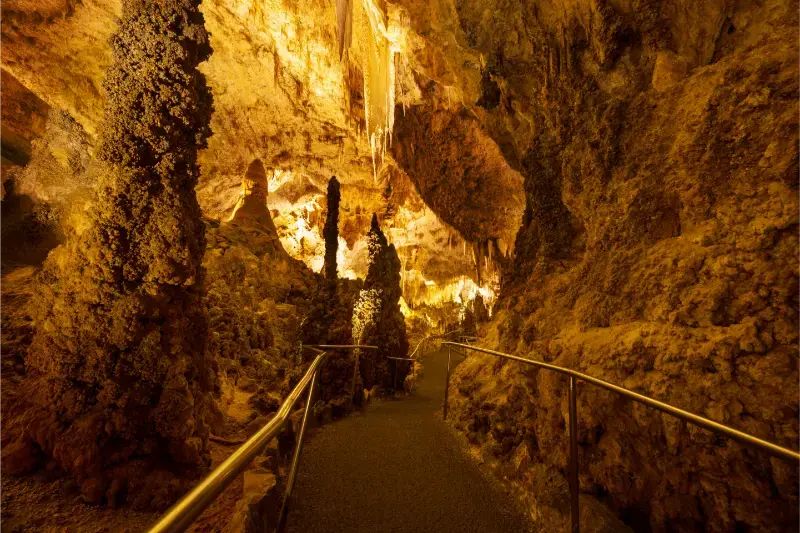
The cavern is paved in the main self-guided areas, but it is still a cave: surfaces can be wet, lighting is dim, grades change and the underground environment can feel disorienting. Wear closed shoes with reliable traction and carry a light layer because the temperature below ground is much cooler than the desert outside.
Move at the pace of the slowest person in your group. Do not touch formations, step beyond barriers or lean equipment against cave surfaces. Plain water is generally the only drink allowed in the cavern, while food and flavored drinks should remain outside. These rules protect both the cave and the quality of the experience for everyone behind you.
White-nose syndrome precautions are important. If shoes, clothing or gear have been in another cave, follow current NPS guidance before bringing them into Carlsbad Cavern. Visitors walk across bio-cleaning mats when leaving the cavern as part of the park’s disease-prevention measures.
Do not ignore the surface landscape
It is easy to think of Carlsbad Caverns as an underground attraction, yet the park also protects a striking section of the Chihuahuan Desert. The limestone escarpment, desert vegetation and open skies explain the geology and ecology that surround the cave. Even a short surface walk changes how the underground visit makes sense.
Surface conditions are far less stable than cave conditions. Heat, wind, winter cold, lightning and flash-flood risk can make a trail inappropriate on a particular day. The park currently warns that some backcountry routes remain closed because of flood damage, so check the current trail-status page before setting out.
The key decision each morning
Ask one question: which activity is most sensitive to today’s weather? Usually that is the exposed Guadalupe Mountains hike, not the cave. Put the mountain objective into the best weather window and let the cavern, visitor center or easier desert stops move around it.
Final planning advice
For the broader picture, use my Carlsbad Caverns first-time visitor guide. The park rewards a slower pace: reserve what has limited capacity, protect enough time for the Big Room, and leave room for weather or fatigue to change the surface portion of the day.
The strongest trip is rarely the one with the most stops. It is the one where you arrive with the right reservation, understand the physical demands of your chosen route, and still have enough energy to notice the scale, silence and details that make Carlsbad Caverns different from any normal attraction.
How to extend the road trip to four or five days
With a fourth day, add White Sands or a second Guadalupe Mountains hike rather than another long driving loop. With a fifth day, you can slow the schedule enough to include a ranger-guided cave tour and still preserve a weather backup day. Extra time improves this region disproportionately because weather and reservations can force changes.
Travelers flying from El Paso can use the final night in the city rather than driving to the airport before dawn from Carlsbad. That creates a safer departure day and gives you a restaurant-heavy evening after several remote park days.
Road-trip time management
Avoid measuring only drive time. Fuel stops, grocery runs, timed-entry check-in and trail preparation all add minutes. I plan each morning around the first fixed commitment, then add only one major activity after it. This prevents a national-park trip from feeling like a schedule of alarms.
Common two-park mistakes
- Trying to hike Guadalupe Peak after a late Bat Flight night with little sleep.
- Driving with a nearly empty fuel tank because towns look close on the map.
- Assuming the cave and mountain park need the same clothing.
- Skipping a weather backup for the exposed hike.
- Changing hotels every night without actually reducing driving.
- Adding White Sands to a three-day itinerary without adding an extra day.