

Where you sleep around Monument Valley changes the experience more than it does at many Southwest stops. A room with a valley view can turn sunrise into something you watch from a balcony, while a motel in Kayenta can lower the price and put you closer to fuel, groceries and Highway 160. The right choice depends on whether your priority is scenery, a guided tour, a road-trip connection or practical services.
I divide the options into four useful bases: inside or immediately beside Monument Valley Navajo Tribal Park, Goulding’s area, Kayenta, and the Utah-side towns such as Mexican Hat or Bluff. None is automatically best. Match the location to your confirmed tour and to the direction you are traveling the next day.
| Best for iconic views | The View Hotel / cabins at Monument Valley |
| Best full-service resort base | Goulding’s Resort |
| Best for roadside services | Kayenta, Arizona |
| Best for northbound Utah road trips | Mexican Hat or Bluff |
| Biggest booking mistake | Choosing by price before checking drive time and local time |
Staying at The View
The View Hotel is the most location-driven choice because it sits at Monument Valley Navajo Tribal Park and offers hotel rooms, cabins and campground options. Its main advantage is simple: you are already where many travelers are trying to reach for first light. That reduces predawn driving and makes it easier to enjoy the changing light without starting the day in a hurry.
The trade-off is demand. Popular dates can sell out, and the hotel notes that the tribal park entrance fee is separate from the room rate. Read the cancellation policy carefully and do not assume that staying at the hotel includes every park fee or tour. If sunrise photography is a priority, the location can justify a higher nightly rate, but if you only need a bed between driving days, you may prefer a more practical base.
Goulding’s Resort: a practical full-service alternative
Goulding’s sits near Monument Valley and currently offers lodge rooms, vacation villas, RV sites and campground options along with dining, fuel and other services. That combination is useful for families, RV travelers and anyone who wants to reduce driving for meals or supplies. The resort also offers Navajo-guided scenic tours, so it can work as both lodging and an activity base.
The setting still feels close to the valley, though the experience is different from staying directly at The View. Compare actual room views and room types rather than assuming every unit faces the same direction. For a one-night stop with a sunset tour and early departure, the on-site services can be more valuable than a larger room farther away.
Kayenta: the best choice for services and flexibility
Kayenta is farther from the iconic viewpoint but has more of the ordinary road-trip infrastructure many travelers need: fuel, groceries, casual food and a wider spread of hotel inventory. It is a strong base if Monument Valley accommodation is sold out or if the next day continues toward Navajo National Monument, Page or Canyon de Chelly.
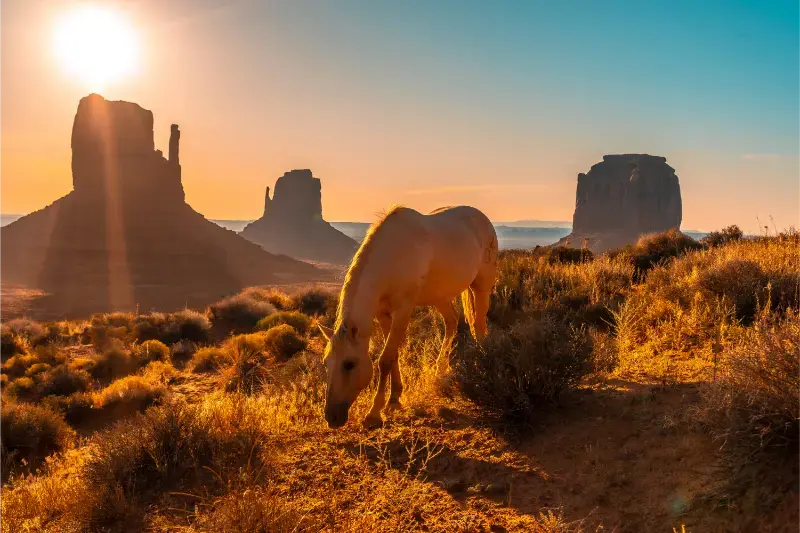
The disadvantage is that sunrise and sunset require extra driving, and that drive can feel longer in darkness or bad weather. If you book a fixed early tour, confirm the local time and give yourself more margin than an online map suggests. For live availability, compare hotels in Kayenta on Booking.com.
Mexican Hat and Bluff
Travelers continuing north into Utah can consider Mexican Hat or Bluff. These bases make the most sense when Monument Valley is one stage of a longer route toward Bears Ears, Moab or the Four Corners region. They can also offer a quieter evening after a busy day in the tribal park.
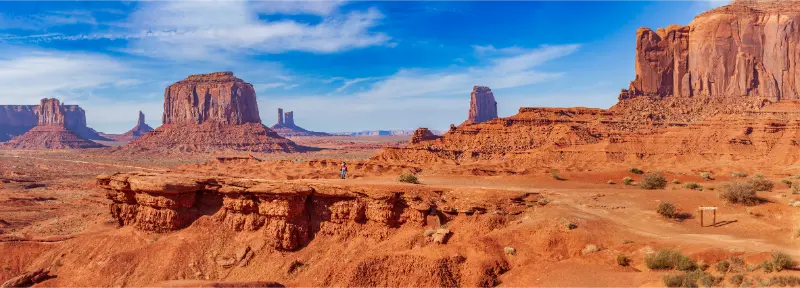
They are less convenient for an early Monument Valley activity than staying at the valley itself, and the added driving should be part of the calculation. A room that appears cheaper can lose its advantage once you add fuel, darkness and the possibility of a one-hour time difference elsewhere on the itinerary.
Camping and RV options
Both The View and Goulding’s advertise camping or RV options, but large RVs and camper vans are not permitted on the Monument Valley 17-mile loop itself. If you are traveling in an RV, separate the overnight question from the scenic-drive question. Park the large vehicle at the campground and use an authorized guided tour if needed rather than assuming you can take the rig down the loop.
Campers should also plan for wind, temperature swings and limited shade. Check current fire rules and campground policies before arrival. In desert country, a comfortable daytime temperature does not guarantee a warm night, particularly outside summer.
How to choose the right base for a one-night stay
For one night, I prioritize the most difficult activity. If you want sunrise at Monument Valley, stay as close as possible. If the main event is a mid-morning guided tour and you need groceries or family-friendly dining, Kayenta can be perfectly practical. If you are northbound to Bluff or Moab, a Utah-side base may save driving the next morning.
Do not build the decision around a hotel rating alone. Look at the exact map position, cancellation terms, meal options and the local time used for your tour. A slightly more expensive room that eliminates a predawn drive can be the better value.
How many nights?
One night is enough for many first-time visitors if you arrive by mid-afternoon, watch sunset, sleep nearby and use the following morning for the scenic drive or a tour. Two nights are worthwhile for photographers, families who want a slower pace, or travelers combining the public loop with a longer Navajo-guided backcountry tour.
If your wider trip already includes Page, Grand Canyon, Canyon de Chelly and Petrified Forest, resist adding extra nights everywhere. Use the Monument Valley first-time visitor guide to decide how much the valley matters relative to the other stops, then place the overnight where it reduces the hardest driving.
Do not forget the Navajo Nation time zone
One of the easiest mistakes on this part of a Southwest road trip is assuming that every place in Arizona uses the same clock. Most of Arizona does not observe daylight saving time, but the Navajo Nation does. From spring into autumn, destinations on Navajo Nation land can therefore be one hour ahead of Page, Flagstaff and the Grand Canyon South Rim. That difference matters when you have a fixed tour, a visitor-center closing time or a sunrise departure. I keep the confirmed local time written next to every reservation instead of relying only on a phone that may switch automatically as it moves between networks.
The safest habit is to confirm the time directly with the tribal park, hotel or tour operator the evening before. Around Monument Valley, Chinle and Navajo National Monument, a one-hour mistake can mean losing a tour or arriving after the last scenic-drive entry. Offline itineraries should show both the place and the time zone, especially if the day starts in Page or Flagstaff and ends on Navajo Nation land.
Heat, wind, storms and winter weather
Northern Arizona can look dry and predictable, but conditions change quickly. Summer heat increases dehydration risk, monsoon storms can produce flash flooding in washes and rough roads, and strong wind can fill the air with dust. Winter can bring snow, ice and freezing mornings at these elevations. The most useful strategy is to check the managing agency shortly before travel and keep a flexible alternative for any activity that depends on a dirt road or canyon access.
Carry more water than the minimum you expect to drink, keep snacks and a warm layer in the vehicle, download maps before losing service and avoid planning the final difficult drive after dark. If rain is falling nearby, treat sandy roads and canyon bottoms conservatively. A route that was simple in the morning can become muddy, rutted or unsafe later in the day.
Travel respectfully on Navajo Nation land
These landscapes are not empty scenery. They are part of a living homeland with communities, homes, livestock, ceremonial places and areas that are not open to visitors. Stay on designated public roads and trails, obey signs and closures, and never follow an unverified map pin onto a dirt track simply because an app shows a shortcut. Access outside public areas may require a permit or an authorized guide.
Ask before photographing people, homes, private property or cultural activity. Drones are prohibited on Navajo Nation land in the tribal park system, and rock climbing on the monuments is prohibited. Buy directly from local artists when possible, use authorized Navajo guides for canyon or backcountry tours and treat photography rules as part of the visit rather than an inconvenience. A respectful trip is also usually a better trip because local interpretation adds context that a scenic stop alone cannot provide.
My booking sequence
I would first lock in any fixed guided tour, then choose the lodging that makes that tour easiest. Next, check whether the hotel provides dinner or whether you need to drive for food. Finally, verify sunrise and sunset times, local time-zone rules and the following day’s route. This order prevents the common mistake of booking a non-refundable room before discovering that the only available tour is at an awkward time.
For the wider route, Monument Valley pairs naturally with Page, Canyon de Chelly and Navajo National Monument. Treat the overnight as part of the itinerary rather than a separate hotel decision, and the whole region becomes easier to enjoy.