

Three full days is the sweet spot for a first Zion trip because it gives you time for the main canyon without treating every shuttle stop as a race. I would use one day for Zion Canyon and a major hike, one for The Narrows plus shorter canyon walks, and one for the east side and Kolob Canyons. That sequence gives you the famous scenery but also a sense of how much larger Zion is than the corridor between the visitor center and Temple of Sinawava.
For 2026, you do not need a reservation to enter Zion National Park or ride the park shuttle. During shuttle season, however, private vehicles generally cannot use Zion Canyon Scenic Drive beyond Canyon Junction, so the day has to be planned around bus access rather than parking at every trailhead. Read our first-time Zion guide first if you need the basic orientation, then use this itinerary as the day-by-day plan.

| Best length | 3 full sightseeing days plus arrival/departure time |
| Best base | Springdale for the easiest shuttle and pedestrian access |
| Reservation to enter? | No general entrance reservation in 2026 |
| Major permit | Angels Landing beyond Scout Lookout requires a permit |
| Best flexibility | Keep Day 1 and Day 2 interchangeable for weather and river conditions |
Before Day 1: make two backup versions of the trip
Zion is one of those parks where the weather can decide the itinerary for you. The Narrows depends on river flow, flash-flood risk and water conditions; Angels Landing depends on your permit window and your comfort with exposure; summer heat can make an afternoon hike far harder than the mileage suggests. I therefore build two versions of the first two days before arriving. If the river is unsuitable, move The Narrows to another day and hike Watchman, Emerald Pools or part of the West Rim instead. If you do not win an Angels Landing permit, Scout Lookout still gives a strenuous and rewarding hike without the chains section.
The official Zion current conditions page should be checked the evening before and again in the morning. Download maps and permit confirmations before entering the canyon because mobile service is inconsistent. In 2026 the park shuttle began service on March 7, with first departures from the visitor center at 7 a.m. through most of the operating season. Exact last-bus times change by season, so never copy an old screenshot from a previous trip.
Day 1 morning: Angels Landing or Scout Lookout
If you have an Angels Landing permit, make Day 1 your permit-driven day. Start from The Grotto, shuttle stop 6, and climb the West Rim Trail toward Scout Lookout. The full Angels Landing hike is about 5.4 miles round trip with roughly 1,488 feet of elevation gain. The final half-mile from Scout Lookout is the exposed chains section and is the portion that requires the permit. Our Angels Landing guide explains the seasonal and day-before lotteries in detail.
Do not treat an early permit as permission to sprint. Walter’s Wiggles and the climb to Scout Lookout are strenuous even before the chains. Carry water, eat before the hike, and budget time to yield to others in narrow sections. If wind, ice, thunderstorms or your own comfort level make the final ridge feel wrong, turning around at Scout Lookout is a successful decision, not a failed hike.
Day 1 afternoon: Emerald Pools, lodge lawn and Pa’rus Trail
After a strenuous morning, choose something flexible. The Emerald Pools system works well because you can stop at the lower pool or continue higher depending on heat and energy. The bridge near Zion Lodge reopened in 2025 after major reconstruction, restoring direct access from shuttle stop 5. Waterfall volume varies with snowmelt and recent rain, so come for the alcoves, canyon perspective and trail rather than expecting a permanent roaring waterfall.
Finish with the Pa’rus Trail near the visitor center if you still want to walk. It is a broad, lower-canyon route that works especially well near sunset and does not require a shuttle ride deep into the canyon. This is also a smart evening to eat in Springdale and prepare dry clothes, footwear and a walking stick for The Narrows if the river looks favorable the next day.
Day 2 morning: The Narrows from the bottom up
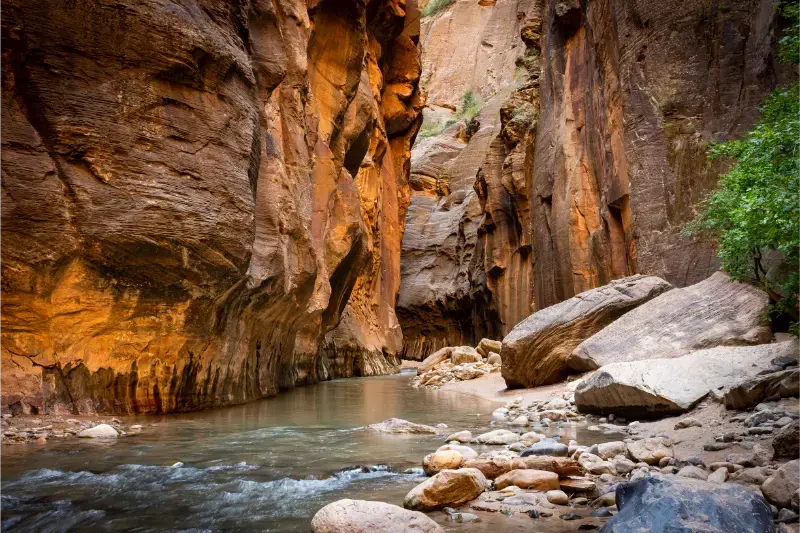
Take the shuttle to Temple of Sinawava and walk the Riverside Walk to the point where the trail enters the Virgin River. The bottom-up Narrows route does not require a permit, and you can turn around whenever conditions, temperature or fatigue tell you to. Big Spring is the farthest legal upstream point for bottom-up day hikers, making the maximum roughly 9.4 miles out and back when the Riverside Walk is included. Our Narrows guide focuses on gear and safety rather than promising a single “must-reach” landmark.
Check the official Narrows information immediately before setting out. The park closes the bottom-up Narrows during sustained high spring flow above 150 cubic feet per second, and flash-flood warnings can close the route at other times. Even when open, cold water, slippery rocks and cyanobacteria advisories deserve more attention than social-media photos.
Day 2 afternoon: Riverside Walk and a low-effort canyon stop
You will already walk the Riverside Walk both directions when entering The Narrows, so the afternoon does not need another ambitious objective. Ride the shuttle back slowly and choose one stop: Big Bend for a broad wall-to-wall canyon view, Zion Lodge for shade and food, or Court of the Patriarchs for a brief change of perspective. The point is to leave enough margin that you are not watching the clock for the last shuttle while exhausted and wet.
If you skipped The Narrows because of conditions, use this day for Watchman Trail early, Emerald Pools later and the Human History Museum area in between. A good Zion itinerary is resilient. The park is too spectacular to let one closed river route or one lost permit define the entire trip.

Day 3 morning: Zion–Mount Carmel Highway and Canyon Overlook
Drive east through the Zion–Mount Carmel Tunnel and the sculpted slickrock landscape beyond it. The one-mile Canyon Overlook Trail is short but not trivial: the surface is rocky, there are drop-offs and parking is extremely limited. Arrive early, use only legal paved spaces and be ready to continue if every designated spot is full. Our Canyon Overlook guide explains the parking problem honestly, which is more useful than pretending the trail has a normal trailhead lot.
Continue toward Checkerboard Mesa and the east entrance rather than turning around immediately after the overlook. The east side has a different texture from Zion Canyon: pale cross-bedded sandstone, ponderosa pockets and open slickrock. It is ideal for a slower scenic morning after two intensive canyon days.
Day 3 afternoon: Kolob Canyons for a quieter finish
Kolob Canyons is about an hour from Zion Canyon and has its own entrance from Interstate 15 at Exit 40. The five-mile scenic road climbs past red finger canyons and trailheads to high viewpoints. Timber Creek Overlook is an easy way to finish the trip with a different horizon, while Taylor Creek is a longer option if temperatures and daylight cooperate. See our Kolob Canyons guide for a dedicated plan.
Do not squeeze Kolob into an already full Zion Canyon day simply because it is part of the same national park. The driving time is real. It works best on Day 3, on the way toward Cedar City or Las Vegas, or as a weather alternative when the main canyon is unusually crowded.
Where to stay for this three-day plan
Springdale is the most efficient base because you can walk or take the town shuttle to the pedestrian entrance and connect with the park shuttle. Staying farther west in Virgin, La Verkin or Hurricane can reduce room rates but adds daily driving and parking uncertainty. Our Zion lodging guide compares the trade-offs. You can also compare current Springdale availability on Booking.com.
If you are continuing an Utah road trip, do not assume one base is best for every park. Zion to Bryce Canyon is manageable as a transfer day, but it should not be combined with a full Zion hike and a long Bryce sunset circuit. Our existing Utah Mighty 5 route helps space the parks realistically.
What to pack for three days in Zion
- A refillable water system with enough capacity for desert heat.
- Trail shoes with reliable grip; separate wet-hiking footwear if you plan The Narrows.
- Downloaded shuttle schedules, trail maps and Angels Landing permit confirmation.
- Sun protection, layers and a light source even for hikes planned in daylight.
- A flexible backup list: Watchman, Pa’rus, Emerald Pools, east-side viewpoints and Kolob.
Frequently asked questions
Do I need a reservation to enter Zion in 2026?
No. Zion does not require a general timed-entry reservation in 2026, and the park shuttle does not require a ticket or reservation. You still need to pay the park entrance fee or use an accepted pass.
Can I do Angels Landing and The Narrows on the same day?
Technically some very fit visitors do, but I would not plan a first trip that way. Both experiences deserve several hours, and combining them magnifies shuttle timing, fatigue, heat and safety problems.
Is three days enough without Angels Landing?
Absolutely. Scout Lookout, The Narrows, Canyon Overlook, Emerald Pools, Watchman, Pa’rus, the east side and Kolob can easily fill three strong days.
Should I stay in Springdale all three nights?
For a first trip, yes if the budget works. The convenience of walking to restaurants and reaching the pedestrian entrance without moving the car often compensates for higher room prices.
My practical planning strategy
I would book lodging first, apply for Angels Landing if it matters to you, and leave the exact order of Days 1 and 2 flexible until the weather and river forecast are clearer. That gives structure without turning the vacation into a rigid schedule.
The best three-day Zion trip is not the one with the greatest number of trail names. It is the one that puts the demanding experiences in the coolest, safest windows and leaves enough unplanned time to look up at the canyon walls. Use the shuttle as part of the experience, not as an inconvenience, and keep one alternative ready for every permit- or weather-sensitive hike.